

Being an English major and a creative writing minor, I’ve made a lot of friends with fellow aspiring authors. I think it’s fun to see the pieces of advice that we’ve each all come to appreciate and share. And I can think of no better way to explore this by sharing these tidbits here! So follow along for some advice and a few cool people to check out!

Obviously I need to start with my own advice. A few weeks ago, I shared some advice for writing poetry, which you can find here. But for novel writing, I have some additional thoughts. While working on a scene for Fae Marked recently, I was trying to detail very specific information about the preparation for the journey to come. What routes they take, who the characters get information from, what they need to pack, blah blah blah. It was dreadful. I was hating writing this scene and just wanted to get to the good stuff. Writers, if you’re bored writing a scene, chances are, readers will be bored while reading it. Don’t be afraid to skip ahead a bit, summarize, or let the reader fill in the blanks.
And of course I can’t leave out my fellow blogger Ava, whose advice is decently similar to my own. We have a lot of power as the author, and nothing is set in stone while we work. She said:
You are literally God in the universe you’re creating: if something feels lame, off, or just isn’t working with the logic you’ve created, you are God. Change whatever’s not working, change the rules that made it not work. People tend to set world building rules at the beginning stages and then get stuck, frustrated or bored when they’re having trouble jamming the narrative, plot, or character attributes in there. Never forget that you’re God, you make the rules, and you can change them whenever and however you want.
A frequent classmate and another blogger is Avery Andrews, who said:
Something I like to do when I sit down to work on a project is pick a music playlist that fits the vibe of whatever I am writing. For example, if I’m writing poetry, I like to find a “writing poetry” or “dark academia” playlist. Then I deafen my airpods and immerse myself in the world.
I love the idea of adjusting the environment to help get you in the zone. It can be hard sometimes to sit and write at your computer when there are also emails, social media, and other distractions. I for one will be trying out her immersion techniques in the future, and hopefully it will keep me focused instead of playing farming sim games.
Avery can be found at her blog, or on insta @averyandrewsink!
Coby Cruickshank-Kennedy was one of my fellow English Education majors, who also dabbles in creative writing. When asked, his advice was the following:
I write to music all the time. I have multiple playlists for each project I work on: typically one for the main character, the main supporting character, and one for the main villain. Each with their own vibe which helps me write their respective scenes. I have 1 song at the top of each that I deem is that respective characters ‘theme’ song, that might play whenever they would enter in a movie scene. Since I do a lot of brainstorming in the car, I also find this style of playlist helps me brainstorm future scenes with specific characters in mind.
Coby and Avery may be onto something. I’m not really great at making whole playlists for characters or novels, but I love the idea of picking a theme song for each character to motivate or set the stage of certain scenes. Personally, I like to make mood boards, which I consider to be the visual equivalent. But regardless of the medium, Coby is right in sharing that we can flesh out our characters and world using the art that’s around us.
Coby can be found on insta @cobyck_writing!
A good friend and coworker, Kathleen was part of my college writing club. While their passions and career have taken them elsewhere beyond much writing, they still supplied:
hmmm I’d say that starting out, one of the reasons people get into writing—or any sort of art—is that they like things. people fundamentally have good taste, and when you start writing what you write is going to feel kind of garbage. it’s important to find things you like about your work and also recognize that it takes a while for your skill to catch up with your taste. and as your taste improves your writing will once again seem worse. it’s a cycle that’s eternal, and that’s not a bad thing! if you’re able to be comfortable in working on your craft and not being where you want to be, eventually you’ll get there. also read widely in genres you don’t write in, and read/watch/listen widely to other forms of art, that’s really helpful. have a life outside of writing
I think this is advice that applies so well to any hobby or craft. They’re fully accurate in that we need to engage in multiple aspects, not just creating. Absorbing and reflecting on all forms of craft can help us improve, and while an endless cycle may seem daunting, hopefully you can find comfort in it.
I got to know Aimee during my last quarter of college, when we took a wonderful fiction writing class together. One of the things we talked about in this class was the concept of architects and gardeners. Aimee found this quote from George R R Martin particularly poignant:
I think there are two types of writers, the architects and the gardeners. The architects plan everything ahead of time, like an architect building a house. They know how many rooms are going to be in the house, what kind of roof they’re going to have, where the wires are going to run, what kind of plumbing there’s going to be. They have the whole thing designed and blueprinted out before they even nail the first board up. The gardeners dig a hole, drop in a seed and water it. They kind of know what seed it is, they know if planted a fantasy seed or mystery seed or whatever. But as the plant comes up and they water it, they don’t know how many branches it’s going to have, they find out as it grows. And I’m much more a gardener than an architect.
I also enjoyed this concept, and it made me feel better about how my projects have been going. I see myself as a weird amalgamation of the two, with a loose blueprint and a lot of seeds to nurture. Aimee said it so well to me when she remarked: “And more importantly, it helped me be okay with how I write”.
And last but certainly not least is another classmate and coworker, Leanne. She shared:
This may be more for plotters than pantsers* but writing one sentence summaries of each chapter’s main points has helped me extremely. It’s helped me keep my stories consistent and also has helped me see how chapters link together or fail to do so. Also I’ve heard this idea that the story has always “been there” it’s just our job to uncover it. That idea has helped me feel less afraid of starting to write and has made me pick up my computer with a more curious and excited outlook. The story may not be how we want it to be yet, but it’s just because we are still uncovering it.
*plotters versus pantsers refers to Libbie Hawker’s Take Off Your Pants, a phenomenal tool for outlining that we read in our Advanced Fiction Writing class in 2024
In the class I shared with Aimee and Leanne, we talked at great lengths about outlining, so it only makes sense for the pair to relate back to this. I think the advice of simplifying chapters can do great things to ensure that the main events are being followed, and that the flow is coming along naturally. And Leanne’s point about the story already exists out there is very poetic. Like a statue pre-existing within the marble, all we need to do is carve it out. There’s so much in my head and so much potential within me, that all I need to do is finally get it onto paper.
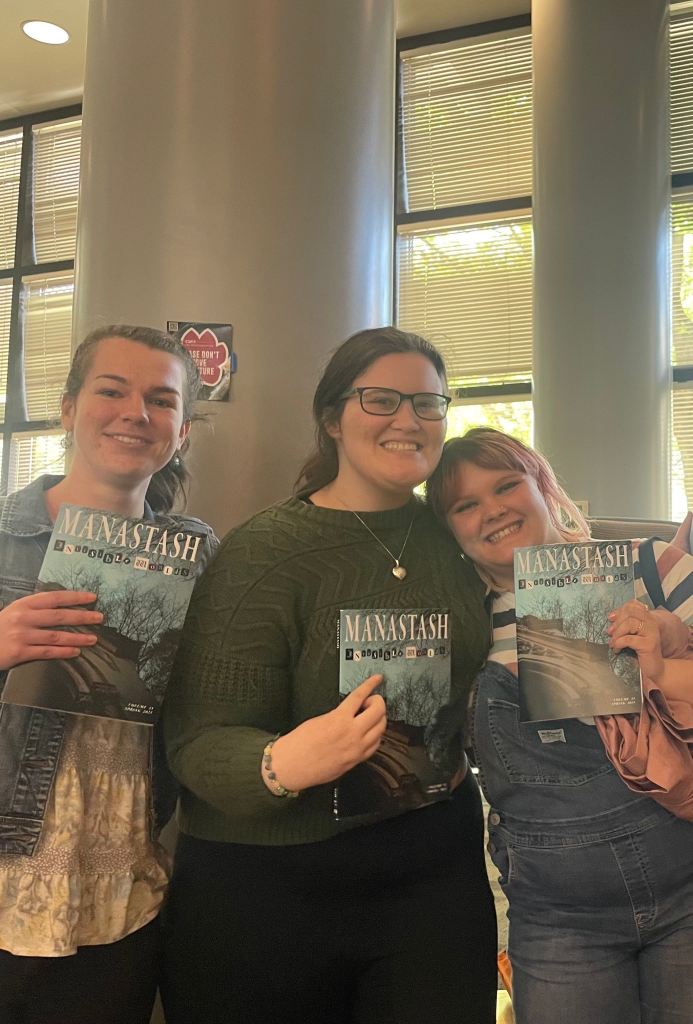
Thank you so much for joining me in this collection of advice! A huge thank you to all those who supplied their thoughts, and for the camaraderie we shared in our college days. May we all continue to aspire, as well as aid those who are following in our example.
This content was written and created by a human, without the use of any artificial intelligence tools. The authors do not authorize this article’s usage in training AI tools. We proudly support the original works of creators and individuals over technology that steals and manipulates original content without consent of creators.

 Pen and Sword Blog
Leave a comment