

It felt like it took me weeks to get through one of my most recent reads, A Fragile Enchantment, by Allison Saft. There’s a lot I could talk about with this novel, from the disappointing political endeavors, the poor characterization of the antagonist, and the ever beloathed miscommunication trope. But one of my biggest grievances lies in the poor LGBTQ representation within the novel.
I am used to novels having side characters with queer identities, and that’s not something I tend to complain about. I don’t mind the small inclusions and natural roles that these characters tend to play, mentioning their partner or being seen happily with them. It tends to be innocent and fun, not adding much but certainly not detracting.
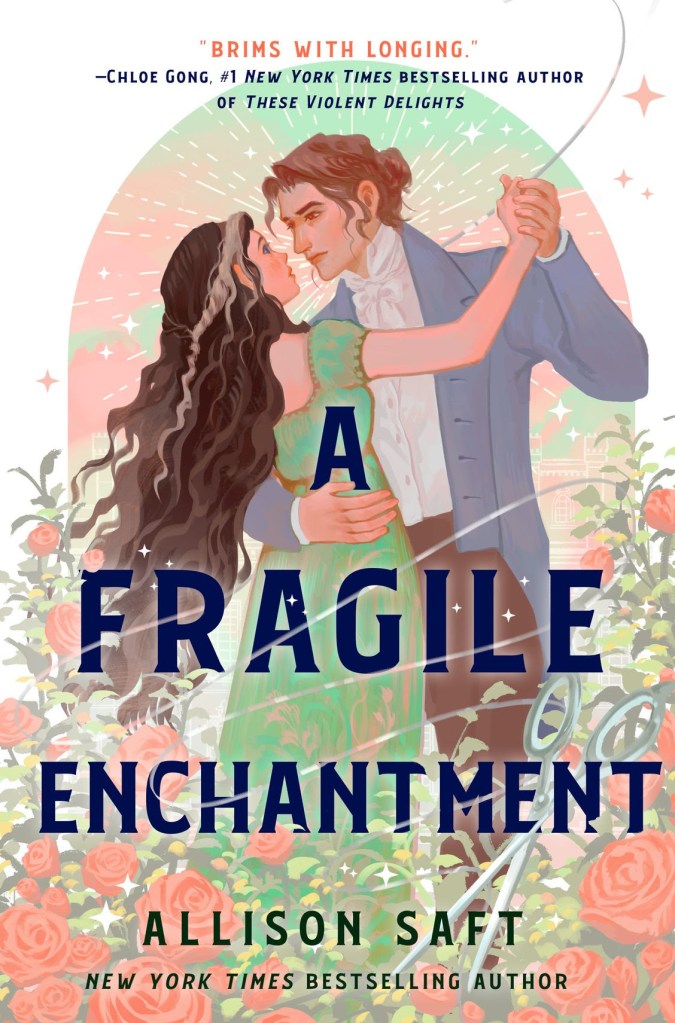
This is not the case in A Fragile Enchantment, where there are five primary characters who identify as queer. While normally this would be an exciting prospect, I have more reason to complain than to celebrate. let’s discuss.
Firstly, the two main characters. Both profess at exactly one point in the novel that, in addition to liking members of the opposite sex, that they also have had same-sex interactions before. The female lead, Niamh, had kissed a girl in her youth, but wasn’t able to proceed any further due to the girl moving. Kit, the male love interest, mentions that he had been chided in his youth for interest in boys and had to squash his feelings. When this conversation happened part way through the book, as Niamh and Kit we opening up to one another, I thought that this would open the door to more conversations between them, relating to their bisexuality. But no. Alas, this is the last time that either of their queer identities is discussed. A simple “You’re like me” is all we get.
Of course I have no issue with bisexual main characters, but I was disappointed at how little it played a role in either of their stories, to the point that the mentions could have been removed entirely with no change in the plot or to their characters at all. Niamh’s innocent kiss with her friend had no affect on their relationship and is never mentioned by either of them, and Kit’s upbringing had plenty of other tragic events that a homophobic father didn’t need to be in the picture at all. It would have been something else entirely if they got to discuss their bisexuality and past dalliances. But as it was presented in the novel, it was unremarkable and pointless.

I suppose the best represented character was the charming nobleman and friend, Sinclair, who professes very quickly to Niamh that he has no interest in courting women, and that it’s part of his social isolation. Sinclair plays the role as the gay best friend in a way, but once again his sexuality seems unimportant in terms of the plot, considering how little it is tied into his character. It’s not even the main reason why he was disowned by his father, which has to do with his unfortunate birth as a bastard son. There’s a potential fake courting plot that is mentioned early on between Sinclair and Niamh, but that’s dropped almost immediately. I would have enjoyed this plot, a sort of lavender relationship, but it quickly fizzles to nothing. Again, all we get between the characters is a “I’m just like you” moment that ultimately means nothing. Sinclair gets no partner or resolution to this aspect of his identity, again making it almost better if it were entirely tossed out.
And lastly, we have the princess and Kit’s betrothed, Rosa, and Rosa’s lady-in-waiting, Miriam. The two are very close, but nothing is explicitly stated for most of the novel. Rosa is marrying Kit purely because of the political benefits, and Miriam is happy to be with her dear friend. It’s not until the very climax of the book, after the wedding has already been called off, that there is something romantic brewing but unexplored, between the two. Miriam’s confession of feelings is what drives Rosa to finally call things off and calm her father down. The two later are linking arms and walking together during the sort of epilogue we see. These are the queer characters I am least upset with, since it actually adds something to the plot and leads to a relationship, but I wish we had gotten more time to see them shine. Niamh has the whole novel to spend making allies, with with Rosa and Sophia, the prince regent’s wife, but she disappointingly does not. And while there are hints throughout the book of the closeness between Rosa and Miriam, there is no real confirmation until the very end, when it becomes convenient for the plot. At least they do wind up together and avoid the nothingness that is the representation seen with the other three.
Perhaps the biggest disappointment at all was the amount of potential contained here. If Sinclair and Kit’s past relationship had been a little more explicit or delved into, it could have meant something more, and added to the depth of their friendship. And I would have loved if Niamh could have reunited with her childhood friend at some point, since their paths almost intersect, and there could have been some sort of connection or conversation between them. I even would have been happier with a more in depth conversation between Kit and Niamh, as they both lament the struggles with being queer in their place and time, but relishing the fact that they were lucky enough to find love in someone that society would respectable. Hell, I was disappointed at the lack of change that was discussed upon their marriage, that there was no promise to change their home kingdom for the better, and make it so people like Sinclair wouldn’t need to hide their sexualities. But none of this was present, and it’s such a shame.

I may seem a bit nitpicky here, and maybe I am a little, but when I’m promised queer rep and get very little, it’s worse than if I was promised none at all. I prefer it when I am pleasently surprised, such as with The Rose Bargain or The Spellshop, where queer romance makes its way into the plot naturally and unexpectedly. It doesn’t feel like needless pandering, like what happened with A Fragile Enchantment.
“So Saige,” you may be asking. “How the hell do I add queer rep into a story without it seeming pointless or pandering?”
Well, I am so glad you asked. Here’s a few pointers I try to keep in mind when I consider queer representation, in my own works or ones that I read:
- Make the character well rounded, and ensure that being queer isn’t the only part of their personality. If it’s a main character, their identity should serve the story more than being a tiny fun factoid. Incorporate it into the world and their lives.
- Make sure that their identity is something crucial to their character or the plot. This way, it doesn’t feel like a label slapped on last minute to get that ‘LGBTQ+” tag on Goodreads.
- Remember that being queer is more than just about sexuality. Gender expression is important representation, too.
- Gender expression and sexuality is a spectrum, and no two queer people are alike. Make sure that this is true for your characters, who may fall anywhere on the spectrum.
- Lastly, if your fantasy settings are going to feature outright persecution and prejudice against queer people, be careful. The world we live in now is already hard enough for many LGBTQ+ individuals, many of whom read fantasy as a way to escape their struggles. For an outlet to suddenly turn into a mirror of their worst fears, it can be startling and uncomfortable to read through.

I know that in the real world, being queer differs from person to person, as well as how they present and the role that their identity plays in their life. But it makes me so sad to see such potential squandered, or for novels to add queer characters to be trendy or cool. For many, being queer is a struggle, meaning that realistic and well thought out representation is so so important.
So dear readers, I challenge you to think critically when it comes to LGBTQ+ representation in the media we consume. As readers and writers, we have a duty to praise and support the works that uplift the voices of the marginalized, as well as criticize and challenge improvement from those who seek to belittle the importance of representation in today’s world. We all play a part. Let your voice be heard and aid those who need our help, now more than ever.
This content was written and created by a human, without the use of any artificial intelligence tools. The authors do not authorize this article’s usage in training AI tools. We proudly support the original works of creators and individuals over technology that steals and manipulates original content without consent of creators.


 Pen and Sword Blog
Leave a reply to Five Books I Almost DNF’d (And One I Actually Did) – Pen and Sword Blog Cancel reply